Home > BMS Control Design for Lithium Battery Systems
BMS Control Design for Lithium Battery Systems
A good BMS monitors battery status, manages charge/discharge, protects devices, and integrates with equipment for visibility, control, and predictability.
LARGE's BMS covers electrical safety, intelligent algorithms, communication protocols, data acquisition, low-temperature heating, and OTA, widely used in medical, robotics, and industrial applications.
Why Standard BMS Can't Meet Professional Device Needs
(SMBus / RS485 / CAN)
Core Lithium Battery BMS Custom
Functions (Hardware & Software)
Communication Customization
Communication protocols
Communication protection
SOC display
Current detection
Battery fault logging
Cycle life monitoring
Charge Management Customization
Overcharge protection
Overcurrent protection
Overheat warning/protection
Low-temperature warning/protection
Charge short-circuit warning/protection
Charge balancing
Discharge Management Customization
Over-discharge protection
Low-voltage discharge protection
No-load protection
Discharge short-circuit warning/protection
High-temperature discharge warning/protection
Low-temperature discharge warning/protection
Other Enhanced Features
Low-temperature self-heating
Ultra-low power (storage mode)
Reverse polarity protection
Full-charge storage self-discharge management
Self-diagnosis
Voltage difference anomaly detection
BMS Product Architecture
By Control Type (Control Architecture)
Pure Hardware Protection (PCM): Provides overcharge/over-discharge/overcurrent/short-circuit/temperature protection; fast response, low cost
Pure Software Control: Supports CAN/RS485/UART communication, SOC/SOH algorithms, SOC display, and data logging
Hardware + Software (Hybrid BMS): Safety and intelligence in parallel; industrial-grade standard solution
By Port Structure
Common Port: Shared charge/discharge port; simple structure, cost-effective Separate Port: Independent charge/discharge ports; higher safety, ideal for high-end devices
By Board Form Factor
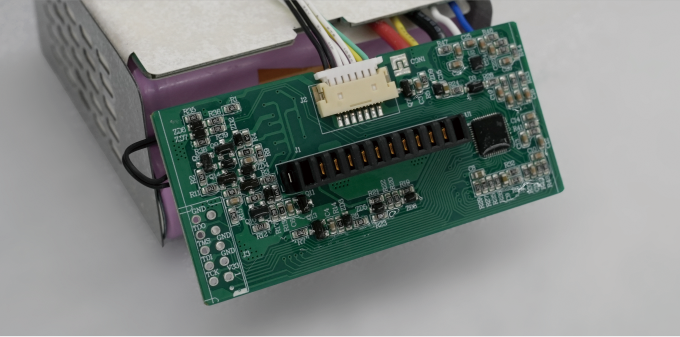
PCB (Rigid Board): Stable, reliable; standard industrial solution FPC (Flexible Board): Thin and flexible; suited for portable or medical devices
Rigid-Flex: Combines reliability and bendability; fits precise structures
By Balancing Strategy
Passive Balancing: Mature solution, low cost
Active Balancing: For high-end applications; improves consistency and lifespan (energy storage / AGV / power systems)
Functional Modules (Expandable)
DC-DC module (powers MCU/peripherals)
Pre-charge module
Balancing module(active/passive)
Low-temperature self-heating module (activates at -20°C)
Communication modules: Bluetooth / NFC / 4G / WiFi
Data logging and recording system
Core Advantages of Customized BMS for Lithium Battery
High-Precision A
lgorithms
Communication Compatibility
Multi-Layer Safety
Protection
Remote Operation & Maintenance
Testing & Validation
· Protection strategy verification (overcharge/overcurrent/short-circuit response time
· SOC accuracy testing under high/low temperature
· Communication consistency testing (CAN/RS485/UART)
· Measurement accuracy testing (voltage/current/temperature)
· Active/passive balancing efficiency testing
· Short-circuit/overcurrent response time testing
· Fault event logging verification
FAQ
Can the BMS adapt to my device using CAN protocol?
Supports CAN (250kñ1MB) and multi-protocol customization for seamless compatibility.
How accurate is the SOC display?
Error ≤3%, reflecting true remaining capacity and preventing unexpected shutdowns.
Can the BMS be upgraded remotely?
Supports OTA updates without battery removal, enabling convenient algorithm and feature upgrades.
What is BMS on a lithium battery?
A BMS (Battery Management System) monitors and protects lithium batteries, controlling charging/discharging, cell balancing, and ensuring safety.
How to choose the right BMS for my device?
Select a BMS based on battery voltage, capacity, current rating, number of cells, and application requirements.
What communication protocol is better for robots?
CAN bus is preferred for robots due to reliable, real-time multi-device communication.
Do you support customized charging strategy?
Yes, BMS can be configured with custom charging profiles to optimize performance and battery lifespan.
How to evaluate BMS safety?
Check overcharge, over-discharge, overcurrent, short-circuit protection, thermal monitoring, and compliance with industry safety standards.
How to wire a BMS while still allowing discharging through the battery?
Connect the BMS according to the manufacturer wiring diagram, ensuring load connections pass through the BMS’s output terminals for proper monitoring.
Can a bad battery cause PCM problems?
Yes, a faulty battery can trigger PCM (Protection Circuit Module) faults, causing unexpected shutdowns or communication errors.
Request Your Custom Battery Pack Evaluation
We'll provide a tailored evaluation covering cell design, BMS strategy, structure, thermal management and safety engineering.