

Home > Battery Calculations
Lithium-lon Battery Selection & Engineering Calculation Guide
Designed for industrial equipment, medical devices, robotics, and specialized applications, this page presents a system-level, engineering-oriented guide to lithium-ion battery selection and core calculation methods.
All formulas and parameters provided here are intended for early-stage feasibility assessment and engineering estimation. They help determine whether a battery concept is viable during the design phase, rather than replacing detailed engineering design, prototyping, or validation testing.
Who This Guide Is For
- R&D engineers involved in lithium battery selection and system design
- Product managers and technical buyers evaluating battery size, current, and runtime feasibility
- Companies planning to customize lithium-ion battery packs for equipment-level applications
If you are looking for a manufacturable, deliverable, and verifiable battery solution — not just a theoretical calculation — this guide is for you.
Define Application Requirements (Starting Point)
Before any calculation begins, the real operating requirements of the device must be clearly defined.
This step determines the stability of all subsequent battery decisions.
Key parameters to confirm include:
- Operating voltage range (V)
- Rated power or continuous operating current (W / A)
- Required runtime per cycle (h)
- Peak current demand
- Operating temperature range
- Maximum allowable battery size and weight
In practical engineering projects, the earlier these constraints are clarified, the lower the risk of redesign and rework.
Core Battery Parameters and Fundamental Calculations
In real-world design, engineers typically add a 10-30%
safety margin to account for aging, temperature effects,
and operating variability.
Voltage (V), Capacity (Ah), and Energy (Wh)
Three parameters define most lithium-ion battery systems:
Voltage (V): determines the system voltage platform
Capacity (Ah): defines stored charge
Energy (Wh): determines total usable energy and is a key factor for transportation and certification
Common Engineering Formulas
Battery Energy:
Battery Energy (Wh) = Battery Voltage (V) × Capacity (Ah)
Required Capacity Estimation:
Required Capacity (Ah) = Power (W) × Runtime (h) ÷ Voltage (V)
Or:
Required Capacity (Ah) = Continuous discharge current (A)×Operating time (h)
From Cell to Pack: Series & Parallel Configuration
What Do Series (S) and Parallel (P) Control?
| Series (S) | increases pack voltage |
| Parallel (P) | increases capacity and output current capability |
Common Battery Pack Formulas
| Pack Voltage | Cell Voltage × S |
| Pack Capacity | Cell Capacity × P |
| Pack Energy (Wh) | Cell Voltage × Cell Capacity × S × P |
In practical projects, S/P selection must also consider discharge rate, current density, BMS limits, thermal management, and mechanical space — not mathematics alone.
Discharge Current and Runtime Estimation
Many online calculators use a fixed value of 0.8, which is a simplified representation of this correction model.
 High peak-current capability
Runtime (h) = Pack Capacity (Ah) ÷ Load Current (A)
Engineering-Level Runtime Correction Model
In real applications, lithium-ion batteries rarely deliver 100% of their nominal capacity. Therefore, engineering calculations introduce a usable capacity correction factor.
Practical Discharge Time (h)
=Battery Capacity (Ah) × Usable Capacity Factor ÷ Load Current (A)
Usable Capacity Factor accounts for:
- Discharge rate effects
- Operating temperature deviation
- BMS cutoff strategy
- Cell aging and consistency margin
- Safety and reliability reserves
Typical engineering values:
Room temperature, low discharge rate: 0.85 – 0.90 Moderate discharge or mild low temperature: 0.80 – 0.85 High discharge or low-temperature operation: 0.70 – 0.80
What Do Series (S) and Parallel (P) Control?
Lithium-ion batteries typically follow a constant current + constant voltage (CC/CV) charging profile. As a result, charging time cannot be calculated by simple division.
What Do Series (S) and Parallel (P) Control?
Charge Time ≈ Capacity (Ah) ÷ Charge Current (A) × Safety Factor
- Safety factor is typically 1.2 – 1.5
- Exact value depends on cell chemistry, charging strategy, and temperature
Engineering-Level Battery Pack Size Estimation
Without considering multi-layer stacking, the footprint of a single-layer lithium-ion battery pack is primarily determined by the number of rows and columns of cells arranged on a plane.
Define Cell Dimensions and Layout
- Cell type (cylindrical / prismatic / pouch)
- External cell dimensions
- Cylindrical: diameter × height
- Prismatic / pouch: length × width × thickness
- Cell layout and quantity per layer (Rows × Columns)
Goal: define how cells are arranged in the plane to enable array size estimation.
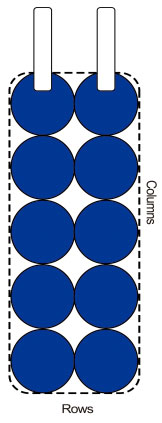
Theoretical Cell Array Dimensions (Rows × Columns)
Rows: number of cells along the length direction
Columns: number of cells along the width direction
Cylindrical cells (regular matrix):
Layer Length ≈ Rows × Cell Diameter
Layer Width ≈ Columns × Cell Diameter
Layer Height ≈ Cell Height
Prismatic / pouch cells (planar layout):
Layer Length ≈ Rows × Cell Length
Layer Width ≈ Columns × Cell Width
Layer Height ≈ Cell Thickness
In real assembly, allowance must be made for manufacturing tolerances and basic safety clearances. Planar dimensions typically increase by approximately 2-5 mm per direction beyond the theoretical value.
Structural-Level Pack Expansion
This step converts the cell array into a manufacturable and deliverable battery pack, and is often underestimated during early design.
Additional space is required for:
- Cell holders and positioning structures
- Insulation plates (e.g., epoxy sheets)
- EVA cushioning and vibration damping
- Nickel tabs and interconnections
- BMS, wiring, and fastening components
- Enclosure thickness and assembly tolerances
Engineering experience shows that:
The final battery pack outer dimensions are typically 10-20% larger than the theoretical cell array size, depending on structural complexity, safety level, and application environment.
Common Lithium Battery Selection Mistakes and Engineering Risks
Why Involving a Professional Battery Manufacturer Matters
For equipment-level applications, lithium-ion batteries are not standardized components but system-critical modules requiring integrated engineering design.
LARGE provides:
Cell selection and battery pack mechanical design
Customized matching of size, voltage, and capacity
Discharge performance, lifetime, and safety validation
Global compliance support including UN38.3, IEC, and CE
Request Your Custom Lithium Battery Pack Evaluation
We'll provide a tailored evaluation covering cell design, BMS strategy, structure, thermal management and safety engineering.