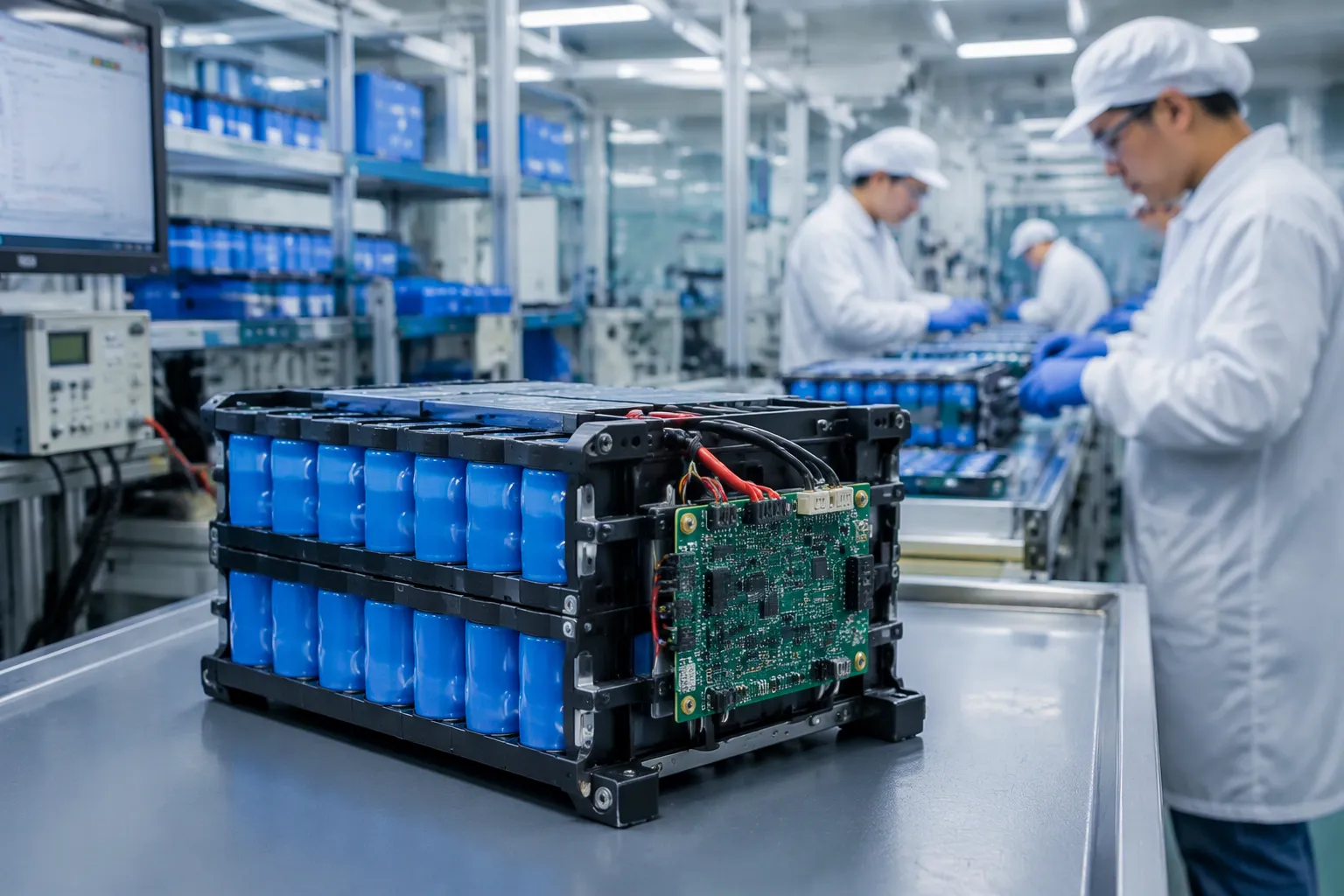
China stands as the world’s largest source of lithium batteries. This guide names ten manufacturers suited to custom OEM and ODM work. A custom lithium battery is a pack built to a buyer’s specifications rather than taken from a catalog. In an OEM arrangement, the buyer supplies the design and the manufacturer builds to it. In an ODM arrangement, the manufacturer owns a platform design and the buyer adapts it for branding, connectors, and firmware parameters, as DLCpo explains. Readers get a comparison table, ten profiles, and a selection framework for any oem / odm battery project. The shortlist covers top 10 custom lithium battery manufacturers in china.
Key Takeaways
-
Write a detailed custom lithium battery pack design requirements before you contact any manufacturer.
-
Check that certificates cover the exact battery model you plan to order.
-
Choose large manufacturers for high-volume orders and specialists for small custom builds.
-
Ask about sample lead time and mass-production lead time separately.
-
Review China’s lithium battery transportation and export requirements if your battery is near 300 Wh/kg.
Top 10 Custom Lithium Battery Manufacturers in China at a Glance
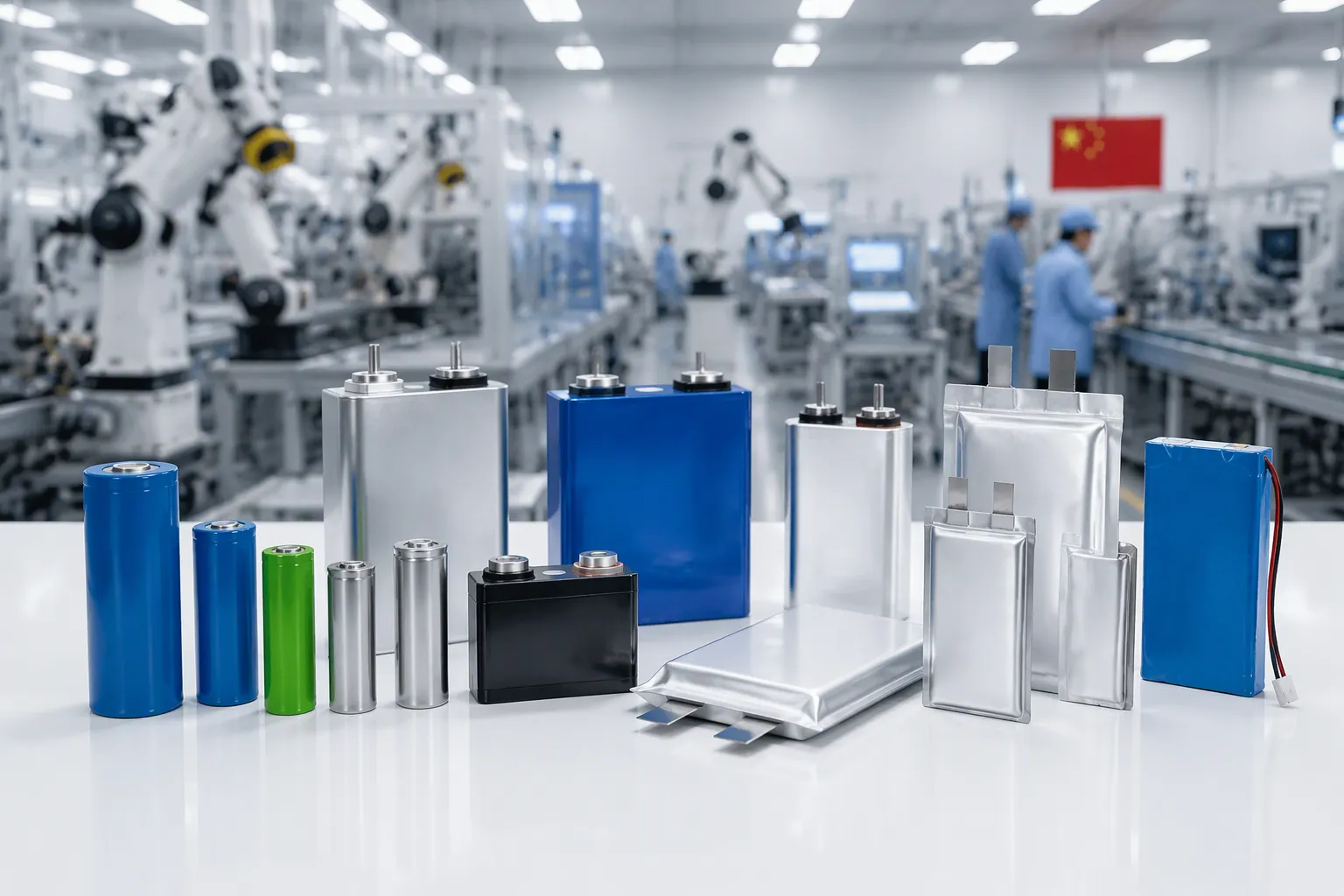
Comparison Table
The table below summarizes the ten companies profiled in this guide. Each row shows where the company operates, what it builds, the certifications buyers commonly cite, and the project types it serves best.
| Manufacturer | Location | Specialties | Key Certifications | Best For |
|---|---|---|---|---|
| CATL | Ningde, Fujian | EV cells and packs, energy storage | UL, CE, UN 38.3, IATF 16949 | High-volume EV and storage programs |
| BYD | Shenzhen | Blade Battery, EV and storage systems | UL, CE, UN 38.3, IATF 16949 | Integrated EV and LFP projects |
| EVE Energy | Huizhou, Guangdong | Cylindrical, pouch, prismatic cells and packs | UL, CE, UN 38.3, IEC 62133 | Consumer, power-tool, and EV packs |
| Gotion High-Tech | Hefei, Anhui | LFP and NMC cells, packs, storage | UL, CE, UN 38.3, IATF 16949 | Cost-sensitive LFP programs |
| CALB | Changzhou, Jiangsu | Prismatic and pouch cells | UL, CE, UN 38.3, IATF 16949 | Prismatic cell engineering |
| REPT BATTERO | Wenzhou, Zhejiang | Prismatic cells and packs | UL, CE, UN 38.3, IATF 16949 | Fast-scaling EV and storage |
| Sunwoda | Shenzhen | Consumer packs, power-tool batteries, EV | UL, CE, UN 38.3, IEC 62133 | Small-format high-volume assembly |
| Hithium | Xiamen, Fujian | LFP cells and storage systems | UL, CE, UN 38.3, IEC 62619 | Stationary storage integration |
| Ganfeng Lithium | Xinyu, Jiangxi | Cells and packs, raw-material integration | UL, CE, UN 38.3, ISO 9001 | Industrial packs with material depth |
| LARGE Battery (Dongguan Large Electronics Co., Ltd.) | Dongguan, Guangdong | Custom Li-ion cells and battery packs; BMS; low-temperature and application-specific solutions | ISO 9001, ISO 14001, ISO 45001, ISO 13485; product certifications include UL, CE, CB, KC, FCC, CCC, UN 38.3, RoHS and REACH (model-dependent) | Customized OEM/ODM packs for medical devices, robotics, industrial equipment and other specialized B2B applications |
How the Shortlist Was Built
This list of top 10 custom lithium battery manufacturers in china combines two supplier types. High-volume cell makers support pack-level ODM work. Customization-focused pack specialists handle smaller, more tailored builds. Company size alone did not decide inclusion, as LARGE Battery notes. Manufacturing scope, sample availability, documentation, and order thresholds matter more.
The evaluation weighed battery chemistry, application focus, cell-to-system capability, and suitability for OEM customization. Certifications such as IEC 62133, ISO 9001, and ISO 14001 counted, per Symbo Battery. So did warranty terms, after-sales support, and reputation. Buyers seeking a china lithium battery supplier for solar, AGV, or medical programs will find candidates here, but each should confirm that certifications cover the exact configuration quoted.
Top 10 Lithium Battery Manufacturers in China: Market Context
Scale and Supply-Chain Depth
China’s position in lithium-ion production rests on control of nearly every stage of the chain. CSIS reports that China produced CSIS analysis of the global lithium-ion battery supply chain and lithium electrolyte solutions as of 2022. The same source puts Chinese output at 70 percent of cathodes, 74 percent of separators, 82 percent of electrolytes, and 85 percent of anodes. Building a lithium ferrophosphate cell factory in China costs about $650 million on average, against roughly $865 million in the United States or Europe, according to CSIS.
| Advantage | Evidence |
|---|---|
| Active materials | About 90 percent of anodes and electrolyte solutions |
| Cell manufacturing cost | $650 million per LFP plant versus $865 million abroad |
| Continued scale | Most global output is projected to stay in China through 2030 |
Sisway Battery describes three drivers behind this depth. A fully integrated chain runs from lithium carbonate refining to cell assembly and BMS engineering inside one country. Dense manufacturing clusters in Shenzhen, Ningde, and Hefei share infrastructure and logistics. Heavy annual spending on next-generation chemistry keeps the engineering base current.
What It Means for Custom Projects
Scale gives buyers of custom packs real advantages. A custom lithium battery manufacturing in China can source cells, separators, and electrolyte locally, which shortens lead times and widens chemistry choices. Engineering teams also sit close to material suppliers, so design changes move faster.
Buyers should still plan for policy risk. In October 2025, China’s Ministry of Commerce issued Announcement No. 58, placing export controls on high-end lithium-ion batteries at or above 300 Wh/kg and on related equipment and materials. Licenses became mandatory from November 8. Most custom packs fall below that threshold, yet programs near the limit deserve early legal review. The shortlist of top 10 lithium battery manufacturers in china above reflects this mature supply base.
CATL
Company Snapshot
CATL founded its business in 2011 and runs its headquarters in Ningde, Fujian. The company builds EV battery cells and packs, and it also supplies energy storage systems. Industry observers widely describe CATL as the world’s largest EV battery maker. That position gives the company a deep engineering bench and a broad cell portfolio.
For buyers, CATL sits at the high-volume end of the market. The company serves automotive programs and grid-scale storage projects. Its production lines run at a scale that few other lithium battery manufacturers can match.
Custom Capabilities and Strengths
CATL supplies large-format cells and takes part in pack ODM partnerships. Automotive and storage integrators can adapt its platforms to their own enclosure, cooling, and BMS designs. The company holds a long list of certifications that buyers commonly request. CATL’s own newsroom lists several UL standards behind its storage and EV products.
| Standard | Description |
|---|---|
| UL 9540A | Test method for evaluating thermal runaway fire propagation in battery energy storage systems |
| UL 1973 | Batteries for stationary and motive auxiliary power applications |
| UL 9540 | Energy storage systems and equipment |
| UL 2580 | Batteries for use in electric vehicles |
CATL also reports that its EnerOne outdoor liquid cooling system and EnerC containerized liquid cooling system CATL’s UL 9540A test report announcement. UL Solutions issued that report at cell, module, unit, and installation level, per CATL. The company describes itself as the first in China to reach that mark.
Common certifications cited for CATL include UL, CE, UN 38.3, and IATF 16949. Its main strengths are scale, consistent lithium-ion cells, and deep R&D. These traits suit programs that need steady lithium-ion supply and tight cell-to-cell consistency. The company’s lithium battery manufacturing base also supports long-run production planning. Buyers who need a proven battery manufacturers partner for EV-grade work often start here.
BYD
Company Snapshot
BYD runs its headquarters in Shenzhen. The company built its reputation on the BYD Blade Battery technology, a long, thin LFP cell design. BYD pairs that cell technology with an integrated EV and energy storage business. The company makes vehicles, cells, and storage systems under one corporate roof.
That structure gives BYD unusual control over its supply chain. Cell production, pack assembly, and end-product integration all happen inside the same organization. Buyers who work with BYD gain access to a supplier with deep experience in both automotive and stationary storage markets.
Custom Capabilities and Strengths
BYD supplies cells and packs for OEM programs. Automotive and storage integrators can build custom packs around its LFP cells. The company’s vertical integration shortens the path from cell to finished system. Its LFP expertise also supports long cycle life and stable thermal behavior.
BYD holds a broad set of certifications. TÜV Rheinland awarded the Battery-Box Premium system official certification for the VDE 2510-50 energy storage standard at BYD’s Shenzhen headquarters. The same systems also received safety certification under the 2PfG 2698 standard:
-
VDE 2510-50 energy storage certification from TÜV Rheinland
-
2PfG 2698 safety certification from TÜV Rheinland
Cybersecurity credentials add another layer. SGS awarded BYD Lithium Battery Co., Ltd. its first-ever SAS-accredited SGS announcement on BYD’s ISO/SAE 21434 certification certification in China. That standard covers cybersecurity engineering for road vehicles.
Common certifications cited for BYD include UL, CE, UN 38.3, and IATF 16949. Among lithium battery manufacturers, BYD stands out for vertical integration and LFP know-how. These strengths suit EV programs and storage projects that need one partner across cell, pack, and system. Buyers comparing battery manufacturers for LFP work often place BYD on their shortlist. The company’s lithium-ion cell lines support both automotive-grade and storage-grade builds.
EVE Energy
Company Snapshot
EVE Energy runs its headquarters in Huizhou, Guangdong. The company builds cylindrical, pouch, and prismatic lithium cells, and it also assembles finished battery packs. That range of formats lets the company serve several markets from one production base. Buyers find EVE cells in consumer devices, power tools, and electric vehicles.
The company sits between the giant automotive cell makers and the small pack shops. It offers automotive-grade engineering without the volume floor of a dedicated EV supplier. This middle position makes EVE a practical stop for programs that need proven lithium-ion cells at moderate scale.
Custom Capabilities and Strengths
EVE Energy provides pack design and ODM support across consumer, power-tool, and EV applications. Engineering teams help buyers match cell format to enclosure space, load profile, and cycle-life targets. The company’s broad cell formats and flexible volumes suit projects that sit below automotive mega-contracts.
Certifications commonly cited for EVE Energy include UL, CE, UN 38.3, and IEC 62133. The company also holds recognition under the new EU battery framework. EVE Energy earned the first-ever TÜV SÜD Mark certificate for electric vehicle batteries under the new EU battery regulation (EU) 2023/1542. TÜV SÜD granted that certification on December 18, 2024.
Automotive credentials extend to the battery management system. EVE Energy holds the following approvals, as reported by PR Newswire:
-
ASPICE CL2, assessed October 31 to November 4, 2022, for the SJ01 BMS project
-
ISO 26262 ASIL D
-
CCS
-
Thiel
-
GBT34131
-
ISO270001
-
ISO26262
Among lithium battery manufacturers, EVE Energy stands out for format breadth and flexible order volumes. Buyers comparing battery manufacturers for power-tool or consumer programs often shortlist the company. Its automotive certifications also give EVE a credible path into vehicle-adjacent work. Programs that need a lithium-ion supplier with both consumer agility and automotive discipline will find a strong fit here.
Gotion High-Tech
Company Snapshot
Gotion High-Tech runs its headquarters in Hefei, Anhui. The company builds LFP and NMC cells, assembles battery packs, and supplies energy storage systems. That product range covers both vehicle programs and grid-scale storage work.
The company also operates across the upstream side of the chain. Gotion works in battery materials, cells, modules, packs, and storage systems, according to Jilipow. This breadth gives buyers one partner from material sourcing through finished pack assembly.
Custom Capabilities and Strengths
Gotion offers pack-level ODM work and joint-development programs. Engineering teams join buyer projects at the platform stage and carry designs through to production. The company’s LFP technology suits electric vehicles, commercial mobility, and energy storage applications, per Jilipow. Its cell manufacturing scale also makes it a potential upstream partner for low-speed vehicle battery projects.
Gotion fits large OEM programs better than small batches. Buyers who need a ready-to-install pack with custom connectors, dashboard communication, or aftermarket packaging often find a specialized pack maker more flexible. Gotion’s strongest fit covers large OEM customers, cell and module procurement, vehicle-platform development, and high-volume industrial battery programs.
The certification portfolio is broad. Gotion’s corporate profile lists the following approvals:
-
Gotion High-Tech corporate profile quality management certification
-
China Classification Society Type Approval Certificate
-
EU ELV material certification
-
UL9540A thermal runaway test certification
-
UL1642 cell certification
-
TÜV SÜD ECE R100 approval, per Lightsource
-
BNEF Tier 1 ranking, per Lightsource
Common certifications cited for Gotion include UL, CE, UN 38.3, and IATF 16949. Among lithium battery manufacturer comparison, Gotion stands out for LFP cost efficiency and a growing global footprint. Buyers comparing battery manufacturers for cost-sensitive lithium-ion storage or vehicle programs will find a strong candidate here.
CALB
Company Snapshot
CALB runs its headquarters in Changzhou, Jiangsu. The company builds prismatic and pouch cells for electric vehicles and energy storage systems. These two formats cover most of the pack architectures that vehicle and storage integrators use today.
The company focuses on cell production rather than end-product assembly. Buyers therefore treat CALB as a cell source first and a pack partner second. This focus gives the company a clear role on a shortlist of lithium battery manufacturers.
Custom Capabilities and Strengths
CALB offers cell customization and pack ODM support. Engineering teams adjust cell dimensions, capacity, and tab placement to fit a buyer’s enclosure and current path. The company then supports pack-level ODM work, where buyers adapt its platform design for their own branding and connectors.
Certifications commonly cited for CALB include UL, CE, UN 38.3, and IATF 16949. These cover product safety, transport, and automotive quality management. Buyers should confirm that each certificate matches the exact cell or pack configuration they plan to order.
Among lithium battery manufacturer comparison, CALB stands out for prismatic cell engineering and stable quality systems. Its prismatic cells suit packs that need a rigid, space-efficient format with predictable thermal behavior. The company’s quality systems also support long production runs without drift in cell performance.
Programs that need pouch cells for lighter packs will find a fit as well. CALB’s dual-format range lets buyers compare prismatic and pouch options from one supplier. That flexibility helps during early design work, when pack geometry is still open. Buyers comparing cell suppliers for EV or storage programs should place CALB on their shortlist and test samples against their own load profiles.
REPT BATTERO
Company Snapshot
REPT BATTERO runs its headquarters in Wenzhou, Zhejiang. The company builds prismatic cells and assembles packs for electric vehicles and energy storage. These two markets share a need for high-capacity cells with stable thermal behavior, and REPT BATTERO designs its prismatic line around that demand.
The company has expanded capacity quickly. That growth gives buyers a supplier with room to scale, and it keeps REPT BATTERO on shortlists for storage programs that expect rising order volumes. Its product line includes the Wending series, which uses the company’s 320Ah high-capacity cells.
Custom Capabilities and Strengths
REPT BATTERO offers pack ODM work and cell-format customization. Engineering teams adjust cell dimensions and capacity to fit a buyer’s enclosure and current path. The company then supports pack-level ODM, where buyers adapt its platform design for their own branding and connectors.
Certifications cover product safety, transport, and storage performance. REPT BATTERO’s research and development page lists REPT BATTERO research and development capabilities. The 320Ah model met TÜV Rheinland certification standards, according to Batteries News. The same source reports that the 320Ah cells were the first in the industry to meet UL 9540A standards for cells above 300Ah.
Marine buyers gain another option. REPT BATTERO supplies marine battery solutions with CCS certification, per its own site. The company also announced that TKDN local content certification and SNI Indonesian National Standard certification would arrive in June, per REPT BATTERO. That step supports localized supply for Indonesia’s energy mix upgrade.
Common certifications cited for REPT BATTERO include UL, CE, UN 38.3, and IATF 16949. Among lithium battery manufacturers, the company stands out for fast capacity expansion and a clear LFP focus. Buyers comparing battery manufacturers for storage or EV programs should test samples against their own load profiles and confirm that each certificate covers the exact configuration quoted.
Sunwoda
Company Snapshot
Sunwoda runs its headquarters in Shenzhen. The company builds consumer battery packs, power-tool batteries, and EV cells and packs. This mix places Sunwoda in a rare spot. It serves phone and laptop makers, tool brands, and vehicle programs from one corporate base.
Consumer electronics demand tight tolerances and fast design cycles. Power tools demand high discharge current and rugged packs. EV work demands automotive-grade quality systems. Sunwoda manages all three, and that range gives buyers a supplier with proven processes across very different load profiles.
Custom Capabilities and Strengths
Sunwoda offers strong pack-level ODM work for consumer and industrial devices. Engineering teams take a platform design and adapt it for a buyer’s enclosure, connector layout, and firmware settings. The company’s small-format pack design suits handheld devices, and its high-volume assembly lines keep unit costs stable at scale. Buyers sourcing an agv battery manufacturers shortlist often add Sunwoda for its compact pack experience.
Certifications commonly cited for Sunwoda include UL, CE, UN 38.3, and IEC 62133. The company’s energy storage cell line carries a wider set, per Sunwoda Energy:
-
GB/T36276-2023
-
UL 1973
-
UL 1642
-
IEC 62619
-
IEC 62620
-
JIS C8715-2:2019
-
UN 38.3
-
DNV bankability report and other third party authoritative certifications
Environmental documentation adds another layer. Sunwoda’s 314Ah energy storage cell became the first battery product worldwide certified by EPD International, with Bureau Veritas conducting the certification, per PR Newswire. That accreditation gives buyers a verified environmental profile for storage programs.
Among lithium battery manufacturers, Sunwoda stands out for small-format pack design and high-volume assembly. Programs that need consumer-grade polish with industrial durability will find a strong fit here. Buyers should confirm that each certificate covers the exact configuration quoted.
Hithium
Company Snapshot
Hithium runs its headquarters in Xiamen, Fujian. The company builds LFP cells and complete systems for stationary energy storage. This focus sets Hithium apart from suppliers that spread their lines across consumer devices, power tools, and vehicles. Every product decision serves grid and commercial storage work.
Stationary storage demands long cycle life, stable thermal behavior, and predictable capacity retention over years of daily cycling. Hithium designs its cells around those demands rather than adapting automotive cells for storage duty. Buyers who need a dedicated storage partner therefore place the company on their shortlist alongside established solar battery manufacturers in china.
Custom Capabilities and Strengths
Hithium offers cell and system customization for storage integrators. Engineering teams adjust cell capacity and format to match a buyer’s rack design, cooling layout, and voltage architecture. The company then supports system-level work, where integrators adapt its platform into a custom energy storage solution for their own brand and market.
Certifications commonly cited for Hithium include UL, CE, UN 38.3, and IEC 62619. These cover product safety, transport, and the safety of industrial lithium cells. Buyers should confirm that each certificate matches the exact cell or system configuration they plan to order, since certificates attach to specific models.
Among lithium battery manufacturers, Hithium stands out for storage-focused cell design and rapid scaling. The company has expanded cell capacity quickly, which gives integrators room to grow order volumes without changing suppliers. That growth matters for projects that start small and scale across multiple sites.
Programs that need fast iteration on enclosure, connectors, and communication protocols will find a responsive partner here. Buyers comparing battery manufacturers for grid or commercial storage should request samples and test them against their own charge and discharge profiles. A supplier that performs well on paper still needs to prove itself in the buyer’s own duty cycle.
Ganfeng Lithium
Company Snapshot
Ganfeng Lithium runs its headquarters in Xinyu, Jiangxi. The company builds lithium cells and packs, and it backs that production with an integrated lithium raw-material business. Few battery makers own this much of the chain. Ganfeng works in lithium extraction, refining, and cell production under one corporate structure.
That structure gives buyers a supplier with unusual depth. Raw material supply, cell fabrication, and pack assembly sit inside the same organization. Polinovel Group lists Ganfeng among the top 15 lithium-ion battery manufacturers in China. The same source notes its “Chinese Outstanding Private Scientific and Technology Enterprise” award. Buyers who value material traceability often place Ganfeng on their shortlist for that reason.
Custom Capabilities and Strengths
Ganfeng offers custom pack assembly and cell supply for industrial applications. Engineering teams match cell chemistry to a buyer’s load profile, duty cycle, and enclosure space. The company then assembles packs with the connectors, housings, and protection circuits each project requires. Industrial buyers gain a partner that controls its own material input, which supports stable pricing and consistent cell quality across repeat orders.
Certifications commonly cited for Ganfeng include UL, CE, UN 38.3, and ISO 9001. These cover product safety, transport, and quality management. Buyers should confirm that each certificate matches the exact cell or pack configuration they plan to order.
Among lithium battery manufacturers, Ganfeng stands out for raw-material integration and solid-state R&D. Its research work on next-generation chemistry gives buyers a path to higher energy density over time. Programs that need industrial packs with material depth will find a strong fit here. Buyers comparing battery manufacturers for long-life industrial work should request samples and test them against their own charge and discharge profiles.
LARGE Battery
Company Snapshot
Founded in 2002, Dongguan Large Electronics Co., Ltd.(LARGE Battery) is a custom lithium battery manufacturer based in Dongguan, Guangdong, China. With 24 years of experience in custom battery development and manufacturing, the company serves B2B customers that need application-specific cells, battery packs, and integrated battery solutions rather than off-the-shelf consumer products.
LARGE Battery has supported more than 70 publicly listed companies and over 2,680 mass-production projects, with cumulative deliveries of more than 68 million battery packs. Its application experience includes medical devices, robotics, industrial equipment, inspection systems, security equipment, and other specialized products.
Custom Capabilities and Strengths
LARGE’s manufacturing setup includes cylindrical, winding, and stacking cell production lines, supported by a total of 17 production lines, comprising cell production lines, assembly lines, and automated production lines, with a stated PACK capacity of 4 GWh. Custom engineering can cover cell selection, pack structure, connectors, enclosure design, protection circuits, and smart BMS integration.
For projects with demanding operating conditions, LARGE Battery develops application-specific solutions including low-temperature, LiFePO4, polymer, and explosion-proof battery options. BMS communication support includes CAN, RS485, and SMBus, subject to project requirements.
Quality and compliance resources include ISO 9001, ISO 14001, ISO 45001, and ISO 13485 management-system certifications, as well as product-market certifications and testing such as UL, CE, CB, KC, FCC, CCC, UN 38.3, RoHS, and REACH, depending on the model and destination market. Buyers should verify the certificate scope and model coverage for the exact configuration being quoted.
LARGE Battery is a relevant option for buyers seeking engineering collaboration, flexible custom configurations, and production support for small-to-mid and scaled B2B programs. The most suitable project fit should be assessed against required chemistry, electrical specifications, operating environment, annual demand, certification needs, and sample-validation results.
How to Choose Lithium Battery Manufacturers in China
Define Requirements and Customization Options
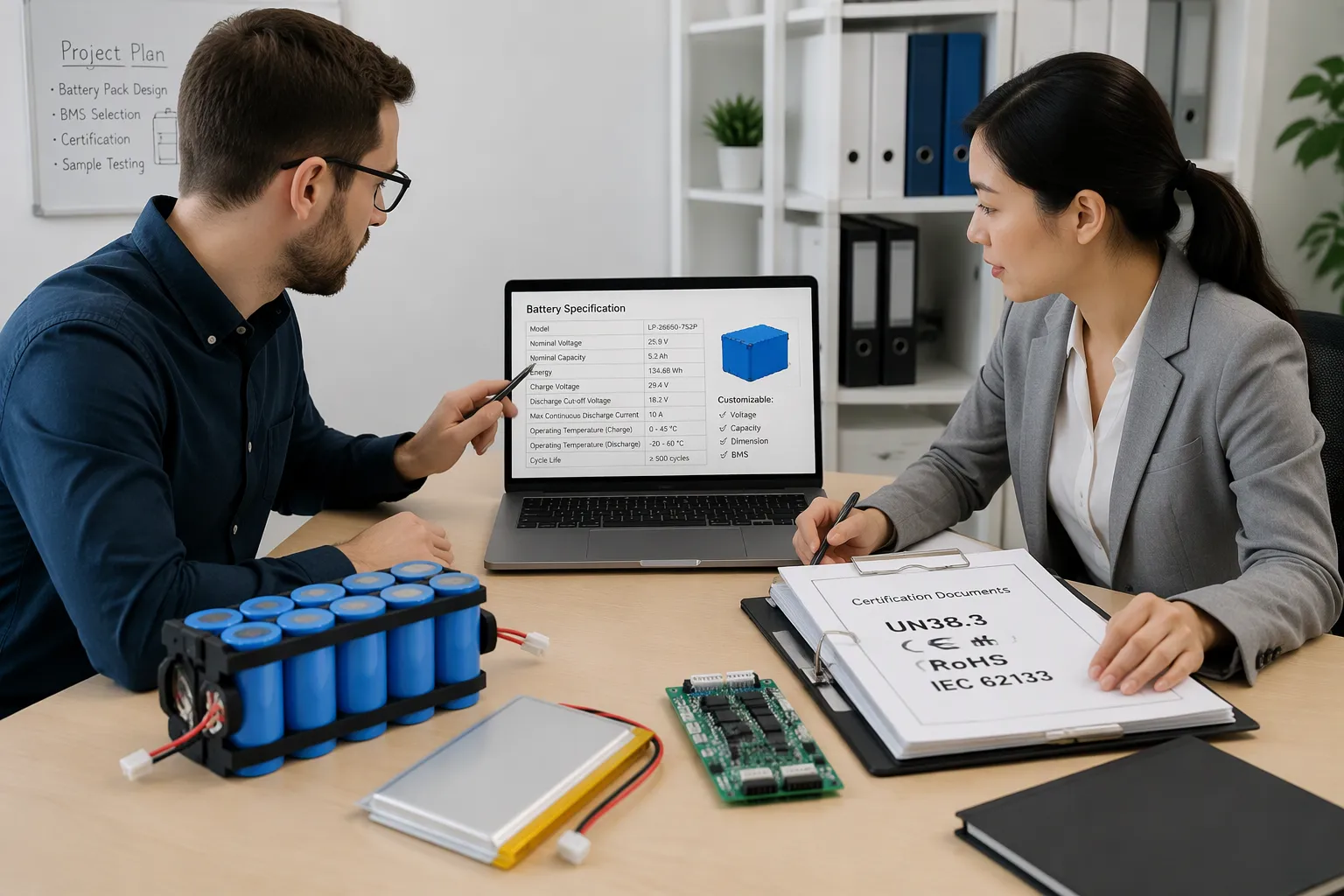
Buyers should start with a written specification before contacting any lithium battery manufacturer in china. The document should state voltage, capacity, discharge current, cycle-life target, enclosure space, connector type, and the operating environment. It should also name the certification each market requires. A clear spec lets every supplier quote the same build, which makes comparison fair.
Order volume shapes the shortlist. Minimum order quantities vary widely by pack type, as Solar Asia Battery notes:
| Battery Type | Typical MOQ | Notes |
|---|---|---|
| Standard cylindrical cell pack (e.g., 18650, 21700) | 500–1,000 units | Lower MOQ if using standard configurations |
| Custom pouch cell pack | 1,000–5,000 units | Higher MOQ due to custom tooling for cell size |
| Custom BMS/PCB design | 2,000+ units | Tooling and firmware development costs need amortizing |
| Energy storage system (ESS) packs | 10–50 units (by cabinet/rack) | Measured in units or MWh rather than piece count |
Sample timing deserves its own question. SZASPOWER advises buyers to separate sample lead time from mass-production lead time, because the two differ. A realistic schedule runs from technical discussion through quotation, design confirmation, prototype, sample testing, design approval, pilot production, mass production, final inspection, and shipment. IP protection belongs in the same conversation. Buyers should ask for a signed non-disclosure agreement and confirm who owns tooling and design files.
Verify Certifications, Testing, and Support
Certificates only count when they cover the exact configuration quoted. Buyers should request the certificate, the model numbers listed, the issuing lab, and the standard edition. A how to evaluate a China lithium battery supplier that hesitates on any of these points warrants caution.
Transport testing follows a defined path. Epec explains that UN 38.3 certification requires eight tests at an accredited lab:
-
T1 Altitude Simulation
-
T2 Thermal Test
-
T3 Vibration Test
-
T4 Shock Test
-
T5 External Short Circuit Test
-
T6 Impact Test
-
T7 Overcharge Test
-
T8 Forced Discharge Test
That testing usually takes four to six weeks, and the report applies only to the tested design. Buyers in solar, AGV, or medical markets should also confirm UL 1642, UL 2054, IEC 62133-2, CE, and RoHS coverage where relevant. After-sales support matters too. Ask how the supplier handles field failures and whether engineering help continues after shipment.
Large-Scale vs. Specialist Custom Lithium Battery From a China Manufacturer
When Volume and Cost Favor Large Suppliers
Large cell makers reward buyers who plan for scale. CATL, BYD, Gotion, CALB, REPT BATTERO, and Hithium run automotive-grade lines with tight cell-to-cell consistency. Their engineering teams design platforms that serve many customers at once. A buyer who adopts one of those platforms gains proven safety data and stable pricing at high volumes.
These suppliers fit EV programs, grid storage, and long production runs. Unit cost falls as order size grows, and the mature supply chain shortens lead times. A lithium battery manufacturer in china at this tier also carries the certifications that automotive and storage markets demand. Buyers with firm forecasts and automotive-grade requirements should start here.
When Flexibility Favors Specialists
Specialists serve a different need. LARGE Battery, Sunwoda, and EVE Energy accept low-to-mid volumes and support fast iteration. Their engineers work directly with design teams on enclosure geometry, connector placement, and firmware settings. A buyer can move from sample to pilot run without committing to automotive-scale quantities.
This route suits medical devices, robotics, AGV platforms, and niche form factors. A china lithium battery manufacturer focused on custom work will often quote a short build that a large cell maker would decline. Buyers sourcing custom lithium battery packs for a new product line gain room to test the market before scaling.
Neither route is better in absolute terms. The right choice depends on volume, timeline, and how much design freedom the project needs. A buyer comparing a china lithium battery supplier should weigh engineering access against unit cost. Teams that need solar battery manufacturers in china for storage work may favor large suppliers, while agv battery manufacturers often favor specialists. Many programs begin with a specialist and migrate to a large supplier as volumes rise. A custom lithium battery from a china manufacturer can come from either tier, so match the supplier to the project stage.
Supplier choice follows the project, not the other way around. Application requirements, order volume, and certification needs point toward either a high-volume cell maker or a customization-focused pack specialist. The lithium battery manufacturer comparison in china differ widely in focus, so buyers should shortlist two or three candidates. Compare them on engineering support and on how samples perform under real load profiles. A strong sample result and responsive engineers matter more than a long brochure. Before contacting any lithium battery manufacturer, write a full specification. Clear voltage, capacity, enclosure, and certification targets let lithium battery manufacturers in china quote comparable builds and shorten the path from inquiry to production.
FAQ
What is the difference between OEM and ODM for a custom lithium battery?
In OEM work, the buyer owns the design and the manufacturer builds to that specification. In ODM work, the manufacturer owns a platform design. The buyer then adapts that platform for branding, connectors, and firmware settings. Both routes suit custom packs, and the right choice depends on how much design control the buyer needs.
What minimum order quantity should a buyer expect?
MOQ varies by pack type. Standard cylindrical cell packs often start around 500 to 1,000 units. Custom pouch packs typically run higher because of tooling costs. Custom BMS designs usually need larger volumes to amortize development. Energy storage packs are often quoted by cabinet or rack rather than piece count.
How long does sample and certification testing take?
Sample timelines differ from mass-production timelines, so buyers should ask about each separately. UN 38.3 transport testing requires eight tests at an accredited lab. That process usually takes four to six weeks. The resulting report applies only to the tested design, so any change to cells or layout may require retesting.
How can a buyer verify that a certificate covers their build?
Buyers should request the certificate itself, the model numbers it lists, the issuing lab, and the standard edition. A supplier that hesitates on these points warrants caution. Certificates attach to specific configurations, so a valid certificate for one pack does not automatically cover a different cell or enclosure.
Do export controls affect custom battery orders from China?
In October 2025, China’s Ministry of Commerce placed export controls on high-end lithium-ion batteries at or above 300 Wh/kg. Licenses became mandatory from November 8. Most custom packs fall below that threshold. Programs near the limit deserve early legal review before quoting or ordering.