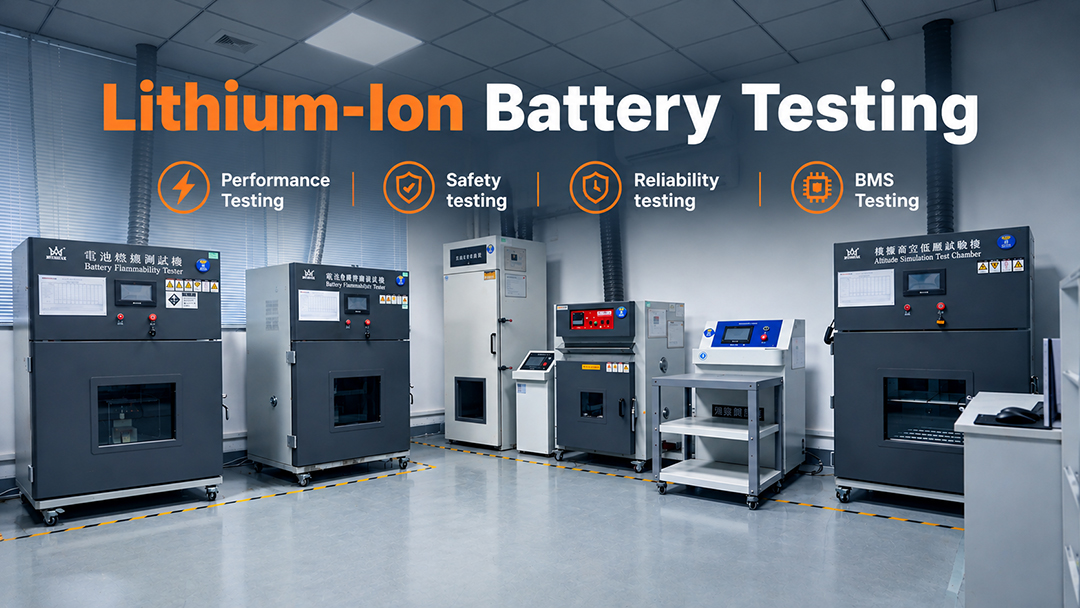
Lithium-ion battery pack testing means running a sequence of electrical, thermal, mechanical, and safety checks. These checks confirm capacity, voltage behavior, thermal stability, and compliance. You start with a visual inspection. Then you check continuity. Next comes welding and internal resistance measurement. After that, you perform Hipot testing and BMS verification. Performance testing follows. Environmental and reliability testing comes next. Safety and abuse testing completes the sequence. This guide covers procedures, equipment, safety protocols, standards, and 2026 trends for engineers, technicians, and hobbyists. Regular testing protects your investment.
The global battery testing equipment market is projected to reach US$ 615.5 million in 2026.
Key Takeaways
-
Regular testing prevents dangerous failures like fires and explosions.
-
Follow a step-by-step testing sequence to check electrical, thermal, and safety performance.
-
Use proper equipment and safety gear to protect yourself and your facility.
-
Meet industry standards like UN 38.3 and IEC 62133-2 for compliance and market access.
-
New trends like automation and AI will make testing faster and more accurate.
Why Lithium-Ion Battery Pack Testing Matters
Safety Risks Of Untested Packs
An untested lithium-ion battery carries hidden dangers. The most severe risk is thermal runaway. Thermal runaway is a chain reaction. Heat from one cell triggers nearby cells to overheat. This leads to fire or explosion. Internal shorts, manufacturing defects, or physical damage start this process. Without regular pack testing, you cannot detect these faults before they escalate.
Swelling and leakage are other risks. A damaged cell releases flammable electrolyte gas. This gas builds pressure inside the pack. The casing can rupture. Toxic chemicals leak out. In worst cases, an explosion occurs. Testing catches these issues early. Voltage checks reveal unstable cells. Internal resistance measurements highlight weak connections. These simple tests prevent dangerous failures.
Performance, Lifespan, And Warranty Impact
Regular lithium-ion battery testing directly protects your pack’s energy storage and cycle life. All batteries lose energy storage over time through chemical degradation. Without testing, you cannot measure this loss or predict failure. Research shows that testing methods affect degradation rates.
| Degradation Phenomenon | D-Rd-C-Rc (with rest) | D-Rd-C (rest after discharge) | D-C-Rc (rest after charge) | D-C (no rest) |
|---|---|---|---|---|
| SEI layer growth (%) | 0.62 | 0.51 | 0.51 | 0.38 |
| Lithium Plating (%) | 0.1118 | 0.1235 | 0.1116 | 0.118 |
| Total capacity fading (%) | 0.73 | 0.64 | 0.63 | 0.50 |
Conditions: 25°C ambient temperature, 0.5C charge rate, 0.5C discharge rate, 2h rest period where applicable
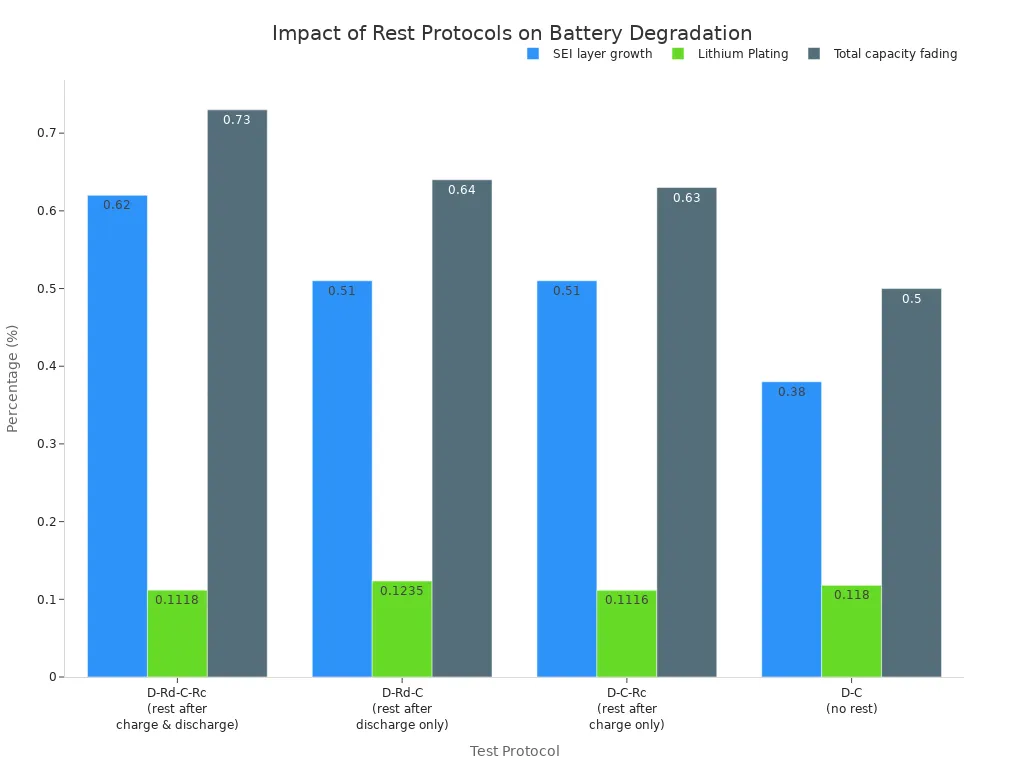
Protocols with rest periods show more degradation than continuous cycling. Real-world use includes rest periods. Standard continuous testing without rest gives overly optimistic lifespan estimates. Testing lithium battery packs with realistic rest cycles gives you accurate performance data.
Warranty claims depend on proper testing. Manufacturers require documented test data to honor warranty terms. Regular testing provides this documentation. It proves you maintained the pack correctly. It flags problems early when repairs are cost-effective. A scheduled testing regimen helps you make informed replacement decisions. This approach extends pack life and protects your investment.
Types Of Lithium Ion Battery Pack Testing
Electrical And BMS Testing
Welding resistance measurement checks the quality of cell-to-busbar connections. Poor welds create hot spots that can trigger thermal runaway. A welding resistance tester passes current through the joint and measures the voltage drop. High resistance means a weak weld that needs rework.
Internal resistance measurement reveals the pack’s overall health. You inject a known current pulse and measure the resulting potential change. Rising resistance signals aging cells or bad connections. This test protects the battery system’s electrical integrity.
High potential (hipot) testing applies a high electrical potential between live parts and the chassis. This insulation test detects leakage paths. A failed hipot test means a short circuit risk. You must fix insulation faults before shipping.
Battery management system (BMS) assessment verifies cell balancing, overcharge protection, and temperature cutoffs. You simulate fault conditions and confirm the BMS responds correctly. A faulty BMS can destroy a lithium-ion battery pack.
Performance Testing
Capacity measurement discharges the pack at a constant rate and records the delivered energy. You compare this value to the rated value. A drop below 80% typically means the pack needs replacement.
Electrochemical impedance spectroscopy (EIS) applies a small AC signal across a range of frequencies. High frequencies reveal ohmic resistance. Mid frequencies show SEI growth. Low frequencies indicate diffusion problems. A growing mid-frequency semicircle points to SEI thickening.
Differential voltage analysis (dQ/dV) plots incremental charge against cell potential. Shifts in peak positions reveal lithium plating or active material loss. This method detects degradation without destroying the pack.
Electrochemical dynamic response testing measures how fast the pack reacts to load changes. A slow response means high impedance or poor electrolyte wetting.
Safety testing covers overcharge, over-discharge, short-circuit, and thermal abuse. Reliability testing includes self-discharge measurement and environmental exposure. Temperature cycling, humidity, vibration, and shock tests reveal long-term weaknesses. These checks complete the lithium ion battery pack testing sequence.
Step-By-Step Lithium-Ion Battery Testing Procedures
Electrical And Performance Test Steps
Follow this sequence for every pack. Stop immediately if you see swelling, leakage, or casing damage.
-
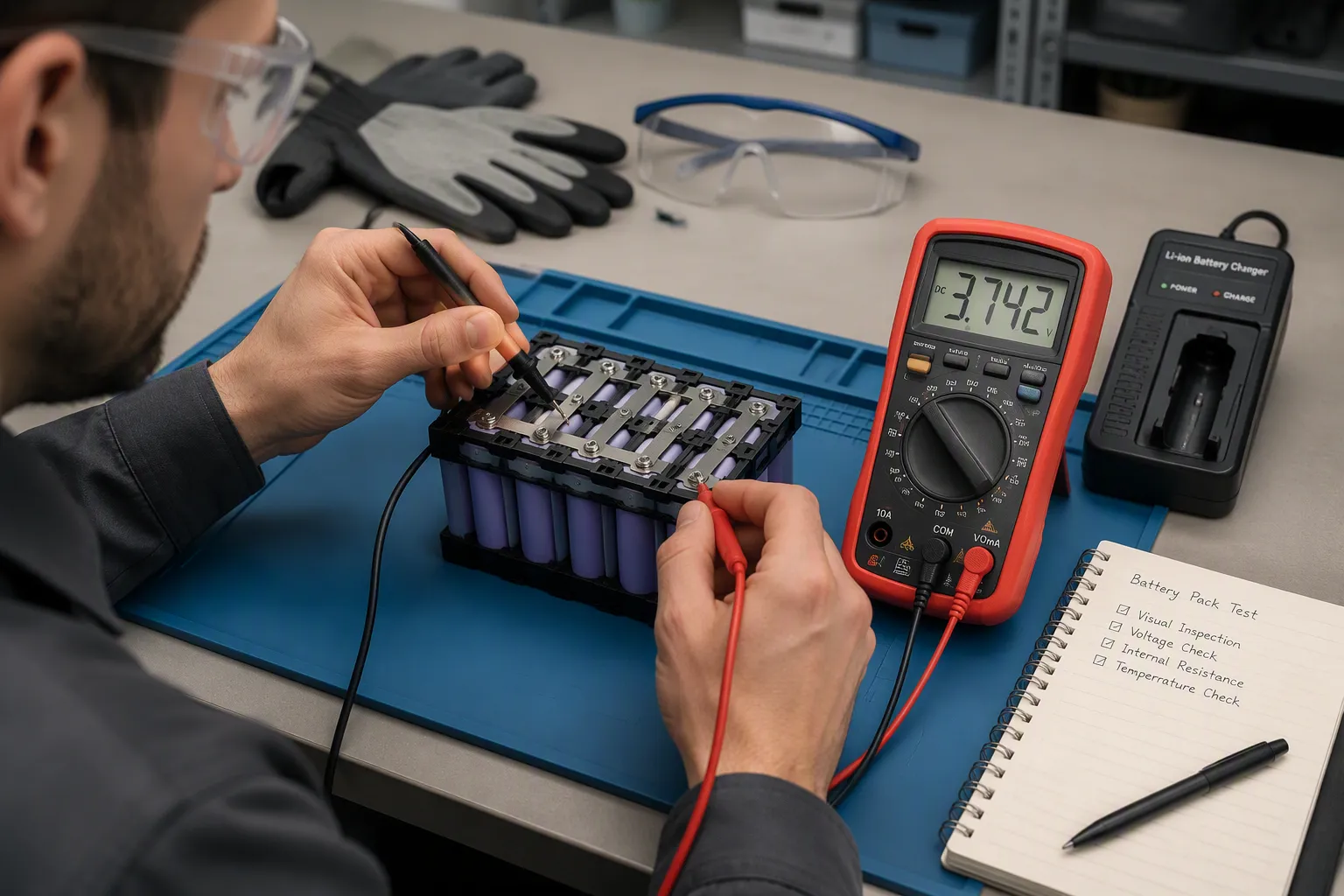
Put on safety glasses. Work on a non-conductive surface. Gather a quality digital multimeter, a chemistry-compatible charger, and your protective equipment.
-
Perform a visual inspection before connecting anything. Look for casing distortion or puffiness from internal gas buildup. Check terminals for white or green corrosion. Examine the wrapper for punctures. Send any defective unit to a recycling facility.
-
Run a voltage check with the multimeter set to DC voltage, typically the 20V range. Place the probes on the battery terminals. A fully charged cell reads about 4.2V. Storage voltage sits near 3.7V. A reading below 2.5V signals deep discharge damage. Do not attempt to revive such a cell.
-
Measure welding resistance at each cell-to-busbar joint. A high reading means a weak weld that will create hot spots.
-
Evaluate internal resistance. Standard multimeters cannot measure this directly. Use Electrochemical Impedance Spectroscopy (EIS) or DC-pulse sequences instead. A low reading indicates a fresh cell. A high reading warns of end-of-life behavior and excessive heat under load.
-
Perform the hipot test between the high-voltage circuit and the enclosure in accordance with the applicable safety standard. Apply the specified test voltage for the required duration. The pass criterion is no arcing.
-
Verify the BMS. Simulate fault conditions. Confirm cell balancing, overcharge protection, and temperature cutoffs respond correctly.
-
Measure capacity through charge/discharge cycling at controlled C-rates. Compare delivered energy to the rated value.
-
Run EIS across a frequency range. A growing mid-frequency semicircle points to SEI thickening.
-
Perform dQ/dV analysis. Shifts in peak positions reveal lithium plating or active material loss.
Safety, Thermal, And Mechanical Test Steps
These procedures demand a controlled facility. Never skip them during lithium-ion battery pack testing.
-
Conduct overcharge testing according to the relevant standard, typically charging the battery beyond its rated voltage while monitoring current and temperature. Cells must not explode or catch fire.
-
Run over-discharge tests to confirm protection circuits cut off before cell damage occurs.
-
Apply short-circuit testing under controlled conditions. Watch for excessive heating.
-
Execute thermal cycling across your target operating range. Monitor for swelling or voltage drift.
-
Mount the pack on a vibration table. Apply vibration per UN 38.3 specifications: 1G from 7 Hz to 18 Hz, then 2G from above 18 Hz to 200 Hz, for 3 hours per axis.
-
Perform mechanical shock tests along all six axes according to the applicable standard, such as UN 38.3 which specifies shock pulses. Verify electrical performance after each stress event.
-
Finish with crush testing. Apply controlled force and observe for thermal events.
Essential Battery Testing Equipment
Electrical And BMS Test Equipment
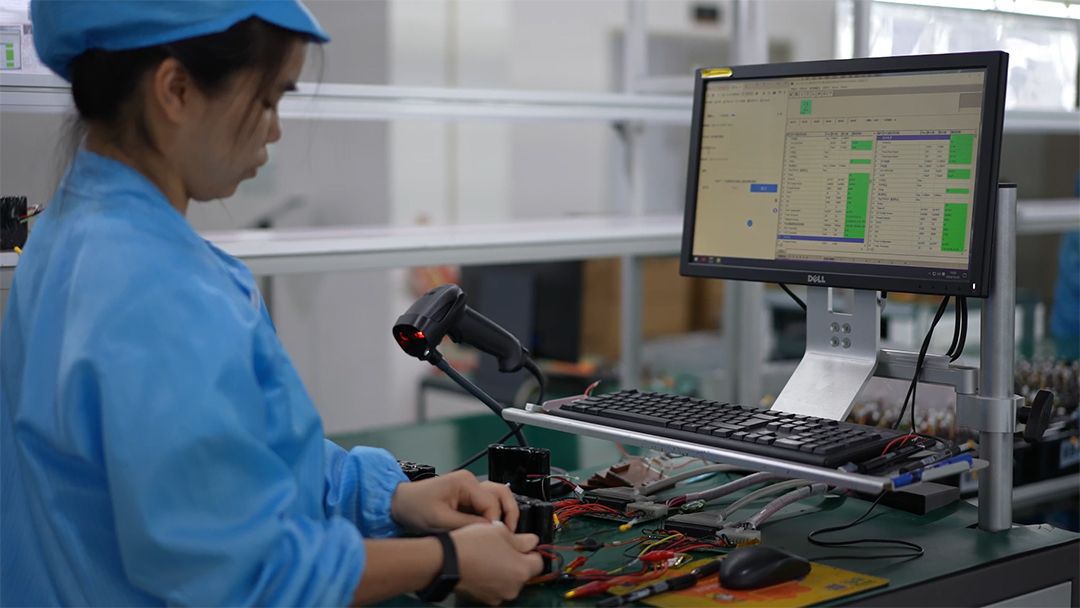
You need a core set of instruments for electrical checks. A digital multimeter handles voltage and continuity readings. A welding resistance tester passes current through each cell-to-busbar joint and measures the voltage drop. An internal resistance meter or EIS analyzer reveals cell aging. A hipot tester applies high potential between live parts and the chassis to confirm insulation integrity. A battery cycler runs charge and discharge profiles. BMS verification tools simulate fault conditions and confirm protection responses.
Choose your battery cycler with care. It must match your chemistry and cover your full voltage and current range with a safety margin. Look for customized charge and discharge profiles, accurate capacity measurement, internal resistance measurement, and pulse testing for high-current scenarios. Data logging should capture voltage, current, and temperature with export options. Safety features must include overcurrent protection, overvoltage protection, and temperature monitoring.
| Key Specification | Considerations |
|---|---|
| Battery Chemistry & Compatibility | Supports the specific chemistry and its charge/discharge characteristics; verify voltage and current ranges |
| Testing Capabilities | Customized profiles, capacity measurement, internal resistance measurement, pulse testing |
| Voltage & Current Ranges | Cover maximum and minimum values with a safety margin for battery variations |
| Data Logging & Analysis | Records voltage, current, temperature; data export; real-time monitoring software |
| Safety Features & Compliance | Overcurrent protection, overvoltage protection, temperature monitoring; safety certifications |
Environmental, Thermal, And Safety Test Equipment
Environmental and abuse testing demands heavier hardware. A thermal chamber capable of reaching the temperature and humidity ranges required by your applicable standards. A vibration table and shock tester are needed for mechanical stress tests. A crush rig applies measured force to the pack. Fire-suppression setups handle thermal events during abuse testing.
These quality control tests for batteries protect your facility and your data. Match each instrument to the standard you must meet before you buy.
Safety Precautions During Testing
Personal Protective Equipment And Facility Setup
You must treat every pack as live and dangerous. Start with personal protective equipment. Wear insulated gloves rated for high voltage. Add a face shield to protect against electrolyte spray. Fire-resistant clothing is mandatory for abuse testing. Never work alone during high-current or thermal tests.
Your facility needs proper engineering controls. Install ventilation that pulls fumes away from your breathing zone. Set up an isolation area with non-conductive surfaces and clear boundaries. Keep a Class D extinguisher and a fire-suppression system within reach. These controls protect you before any lithium-ion battery pack testing begins.
Handling Thermal Runaway And Emergencies
Learn the warning signs before an incident occurs. Early detection saves lives. Watch for external damage such as deformation, melted plastic, corrosion, or frayed wires. Internal damage signs include hissing, crackling, hearing loose parts, visible swelling, heat, smoke, battery electrolyte odor, or refusal to accept charge or provide power.
When you spot these signs, act fast. Follow this sequence:
-
Isolate the affected pack if you can do so safely.
-
Evacuate the area immediately, especially if smoke or fire appears.
-
Call the fire service.
-
Avoid inhaling vapors and avoid direct contact with electrolyte residue.
-
Do not handle hot or venting cells.
-
Let only trained responders attempt suppression. Large amounts of water often cool the pack because extinguishing visible flame may not stop the internal reaction.
-
A trained person may use a portable extinguisher only to control surrounding combustibles or incipient flame, not to stop internal thermal runaway.
Establish a pre-defined emergency plan for damaged or overheating lithium-ion batteries. Pre-plan with your local fire department so first responders understand the technology and risks. Only trained and qualified personnel should attempt to fight a battery fire. Responders must discontinue firefighting and leave the area if smoke quickly fills the room, the fire is not contained, or they cannot fight the fire without respiratory protection. Battery fires beyond the initial stage are extremely dangerous and require self-contained breathing apparatus and heat/fire protective gear.
Lithium-Ion Battery Testing Standards And Regulations
Transport And Product Safety Standards
Shipping lithium-ion battery packs requires UN 38.3 certification. This standard covers a series of eight tests: altitude simulation, thermal test, vibration, shock, external short circuit, impact, overcharge, and forced discharge. Specific test parameters must be verified from the current edition of the standard.
IEC 62133-2 governs portable sealed secondary lithium cells and batteries. UL 2054 applies to household and commercial battery packs. UL 1642 applies to lithium battery cells. These standards ensure your product meets basic safety requirements before market entry.
Industrial, Automotive, And Environmental Standards
For electric vehicle applications, UL 2580 applies. IEC 62660-2 covers lithium-ion cells for electric road vehicle propulsion. Each standard targets a specific application. Match your testing protocol to your product’s intended use.
Compliance Documentation And Certification
Proper documentation proves your lithium-ion battery testing meets requirements. Test reports must include traceability data, equipment calibration records, and pass/fail criteria. Certification paths vary by market. North American markets typically require UL listings. European markets demand CE marking with applicable IEC standards. Asian markets have their own national adoptions.
Standards and editions may change for 2026. Verify the latest revisions, national adoptions, scope, and applicable certification requirements before testing. Check with accredited testing laboratories for current requirements in your target markets.
Interpreting Test Results
Reading Capacity, Resistance, And BMS Data
Raw numbers mean little without context. You need reference points to judge battery performance and health. Start with capacity. Compare your measured battery capacity to the rated value. A significant drop signals end-of-life for electric vehicle packs. Manufacturers set limits to prevent noticeable performance loss. Your real-world capacity may differ from lab results. Test conditions affect lithium battery capacity readings.
Watch for rising internal resistance. A gradual increase signals cell aging. A sudden jump points to a loose connection or weld defect. Track this value over time. The trend matters more than any single reading. For voltage, look for cells that drift apart during cycling. A growing gap between the highest and lowest cell voltage indicates imbalance. The BMS should flag this condition. Check the fault codes your system reports.
Common Failure Modes And Fixes
Cell imbalance ranks among the most frequent problems in multi-cell li-ion battery packs. One cell charges faster or discharges deeper than its neighbors. The BMS may attempt active balancing. This technique transfers energy between cells with high efficiency. If imbalance persists, test each cell individually. Replace any cell that falls outside the acceptable voltage window.
Welding defects create resistance hot spots. A poor weld raises local resistance. This heat accelerates degradation. Re-weld any joint that fails the resistance check. Self-discharge above normal levels suggests internal shorts or contamination. Isolate the affected cell and replace it. Thermal issues often trace to cooling problems. A loose fan plug or failed fan causes temperature differences across the pack. Inspect the cooling system and temperature probes. Address these faults during lithium-ion battery (lib) pack evaluations. Early correction prevents small defects from becoming safety hazards.
Lithium-ion Battery Testing Future Trends For 2026

Automation, AI, And Digital Twins
Automated test lines reshape how you perform lithium-ion battery pack testing. These systems run your entire sequence without operator intervention. They measure welding resistance, internal resistance, and capacity automatically. This reduces human error and speeds up production.
AI-driven anomaly detection takes this further. Machine learning algorithms analyze test data in real time. They spot patterns that indicate emerging faults. A sudden rise in internal resistance or voltage drift gets flagged before it becomes a problem. This predictive approach helps you prevent failures rather than just detect them.
Digital twins represent another leap. A battery digital twin is a virtual copy of your physical pack. It uses sensor data such as current, voltage, and temperature to generate the State of Charge. The twin connects across the entire battery life cycle. It provides enhanced computational capacity, real-time data analysis, and predictive maintenance. Machine learning algorithms within the twin support these tasks. Supporting technologies like Big Data, AI/ML, IoT, and cloud computing make this possible.
New Materials And Evolving Requirements
Solid-state batteries and silicon anodes demand new test protocols. Unlike liquid electrolyte cells, solid-state cells require applied pressure during operation to maintain contact between the solid electrolyte and active materials. Testing must incorporate precise, repeatable force control. Your fixtures must apply uniform load to avoid fracturing ceramic electrolytes.
Solid-state cells resist thermal runaway better due to the absence of flammable liquid electrolyte. You can relax test thresholds. Crush testing must account for brittle ceramic electrolytes that may crack. Thermal abuse tests show higher stability, though phase transitions in ceramic electrolytes introduce cracking risks during thermal cycling. Overcharge tolerance improves, though lithium dendrite formation still requires monitoring. Environmental testing requires less humidity control, though moisture can still degrade certain solid electrolyte materials.
These changes mean your battery testing approach must evolve. You need new fixtures, pressure control systems, and revised pass criteria for quality control solutions for lithium batteries. The 2026 landscape demands that you adapt your methods to match each new material’s unique characteristics.
You now have a full picture of lithium-ion battery pack testing. Electrical and BMS checks catch weak welds and insulation faults. Performance tests track capacity and impedance. Safety, reliability, and environmental checks confirm your pack survives abuse and long-term stress. This routine protects users, extends pack life, and keeps products compliant with 2026 standards.
Build a repeatable test plan. Use the right equipment, follow your safety protocols, and match each standard to your market. Automation and AI will soon handle more of this work. Digital twins and smart anomaly detection will spot faults earlier. Start your routine today, and you will stay ahead of that shift.
FAQ
How often should you test a lithium-ion battery pack?
Test on a fixed schedule tied to use. Run electrical and BMS checks before every deployment. Repeat capacity and internal resistance measurements at regular intervals to track trends. A single reading tells you little. The trend over time reveals aging, weld defects, and imbalance before they become hazards.
What equipment do you need to start testing?
You need a digital multimeter, a welding resistance tester, an internal resistance meter or EIS analyzer, a hipot tester, and a battery cycler. Add BMS verification tools for fault simulation. For abuse and environmental work, you need a thermal chamber, a vibration table, a shock tester, and a crush rig.
What should you do if a pack starts venting or smoking?
Follow your emergency sequence without delay.
-
Isolate the pack only if you can do so safely.
-
Evacuate the area.
-
Call the fire service.
-
Avoid inhaling vapors or touching electrolyte residue.
-
Let trained responders handle suppression.
Large amounts of water often cool the pack, but only trained personnel should attempt it.
Which standard applies to your pack?
The answer depends on your application and market. UN 38.3 covers transport. IEC 62133-2 covers portable sealed cells. UL 2054 covers household and commercial packs. UL 1642 covers cells. UL 2580 and IEC 62660-2 cover electric vehicles. Verify the latest revisions before you test.
How do you know when a pack needs replacement?
Watch for significant capacity loss as an indicator for replacement. A sudden jump in internal resistance points to a loose connection or weld defect. A growing voltage gap between cells signals imbalance. Any swelling, leakage, or refusal to accept charge means retire the pack immediately.